What Causes Basement Water Intrusion?
Water in the basement is one of the most frustrating challenges an Ontario homeowner can face. Whether dealing with minor damp patches along the floor-wall joint or recurring puddles during spring thaws, subterranean water behaves according to hydraulic laws. Understanding how water finds its way into below-grade spaces is the first step toward lasting resolution.
The Role of Hydrostatic Pressure
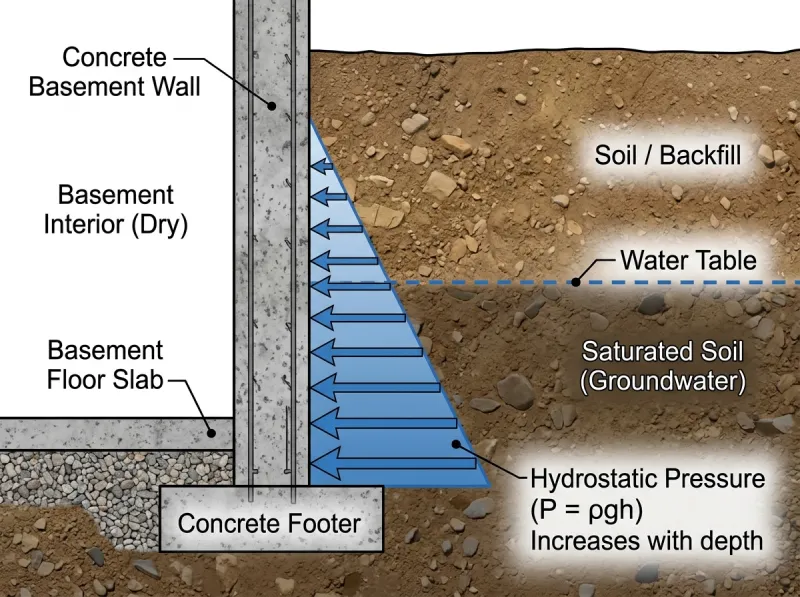
Soil surrounding foundation walls absorbs substantial moisture during rainfall and snowmelt. As the water table rises, the sheer weight of saturated earth generates hydrostatic pressure. Water will naturally follow the path of least resistance—pressing forcefully against porous concrete, mortar joints, and slab edges.
In regions with dense clay soils, such as Durham Region and parts of Simcoe County, water does not drain rapidly through the ground. Instead, it forms a heavy perimeter saturation zone against exterior basement walls.
Common Points of Water Ingress
Basements rarely leak across the entire surface simultaneously; instead, water exploits specific structural joints and vulnerabilities in the concrete assembly.
The Floor-Wall Cove Joint
When a home is built, the foundation footing is poured first, followed by the wall, and finally the interior floor slab. The seam where the slab meets the wall has no continuous waterproof bond, making it the most frequent point of hydrostatic seepage.
Foundation Cracks
Settlement and shrinkage cracks create direct fissures through the full thickness of poured concrete or along block mortar seams, providing an open pathway for groundwater.
Failed or Clogged Weeping Tile
Over decades of service, exterior clay or corrugated plastic drainage tiles can crush under soil weight or fill with silt, causing groundwater to back up against the footing.
Effective Strategies for Long-Term Protection
Effective basement waterproofing focuses on relieving hydrostatic pressure before water enters living or finished storage areas. Interior sub-slab drainage systems collect water along the perimeter and direct it to a sealed sump basin equipped with cast-iron submersible pumps.
Surface grading and downspout management should also be maintained, directing roof runoff at least six feet away from the home.
Frequently Asked Questions
Related Home Protection Services
Basement Waterproofing
Interior sub-slab drainage channels and sealed dual-pump sump systems.
Foundation Repair
Structural epoxy and polyurethane injection sealing foundation wall cracks.
Moisture & Humidity Control
High-capacity dehumidifiers maintaining relative humidity below 55%.
Related Articles
Basement Waterproofing: Understanding Your Options
A comprehensive look at interior versus exterior drainage solutions.
Read GuideFoundation Repair: Warning Signs That Should Not Be Ignored
How to identify when wall cracks require structural stabilization.
Read Guide