Understanding Sagging, Uneven, and Bouncy Floors
When walking across your living room or kitchen, do you notice a distinct springiness, sloping hallways, or gaps developing beneath baseboards? Unstable or sagging floors are common in homes with crawl spaces and older basements. Understanding why floor framing deflects over time is essential for safe structural restoration.
Why Subfloor Framing Weakens Over Time
Floors are supported by a network of dimensional timber joists resting on perimeter foundation sill plates and central girder beams. In crawl spaces and older basements, several factors contribute to structural deflection.
In many older Ontario residences, floor joists were spanned further than modern building standards recommend. Over decades of supporting heavy furniture, appliances, and foot traffic, timber fibers undergo natural creep—a permanent downward sag under sustained dead load.
The Impact of Crawl Space Moisture on Wood
Wood behaves organically with its surrounding environment. In unconditioned, damp crawl spaces, prolonged relative humidity above 70% increases the moisture content of structural timbers.
As wood absorbs ambient moisture, its load-bearing capacity decreases, making joists and beams more prone to bending under ordinary household weight. In severe cases, fungal decay weakens timber fibers near masonry contact points.
Settling Support Posts and Inadequate Footings
Original wooden posts in crawl spaces often rest on bare soil or thin cinder blocks. As soil settles or moisture softens the ground, posts sink, causing central beams to drop.
Interior Warning Signs
Homeowners commonly notice doors sticking at the top corner, cracks in drywall above doorways, and gaps opening between baseboards and flooring.
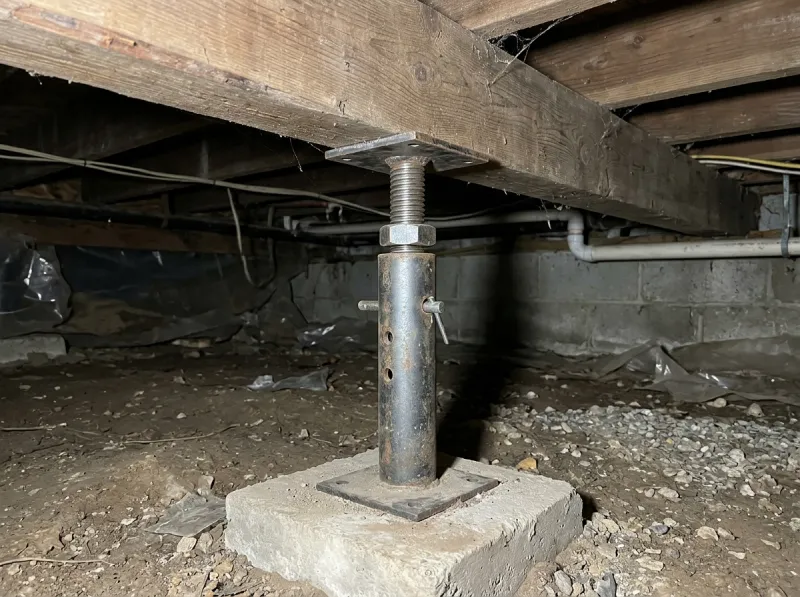
Engineered Solutions: Adjustable Steel Jacks
Temporary wooden shims or lightweight hardware-store jacks do not provide safe, long-term stabilization. Professional remediation involves installing heavy-duty structural steel jack assemblies seated on engineered concrete footing pads.
By distributing loads deep into stable soil and providing precise mechanical adjustment, heavy-duty jacks arrest floor bounce and safely support load-bearing partition walls above.
Frequently Asked Questions
Related Home Protection Services
Floor Stabilization & Support
Heavy-duty screw jacks and supplemental beams for sagging or bouncy floors.
Crawl Space Solutions
Vapor barriers, insulation, and moisture protection for crawl space substructures.
Foundation Repair
Structural wall stabilization, carbon fiber straps, and crack injection.
Related Articles
Signs of Crawl Space Moisture Problems and What Homeowners Can Do
How humidity weakens subfloor framing and what you can do to protect it.
Read GuideCrawl Space Encapsulation: What Homeowners Should Know
Sealing dirt floors to prevent humidity from softening structural beams.
Read Guide